The High Street Didn’t Die. It Was Replaced.

How private equity and corporate landlords are killing independent business in Britain.
Member Blog by Boyowa Olugbo from Stennah & Hope. Never miss a post from Boyowa, head to his Substack to subscribe and come and meet him and other members and friends at our next social event on 19th March at Hackney Bridge. Registration essential, grab your spot here now!
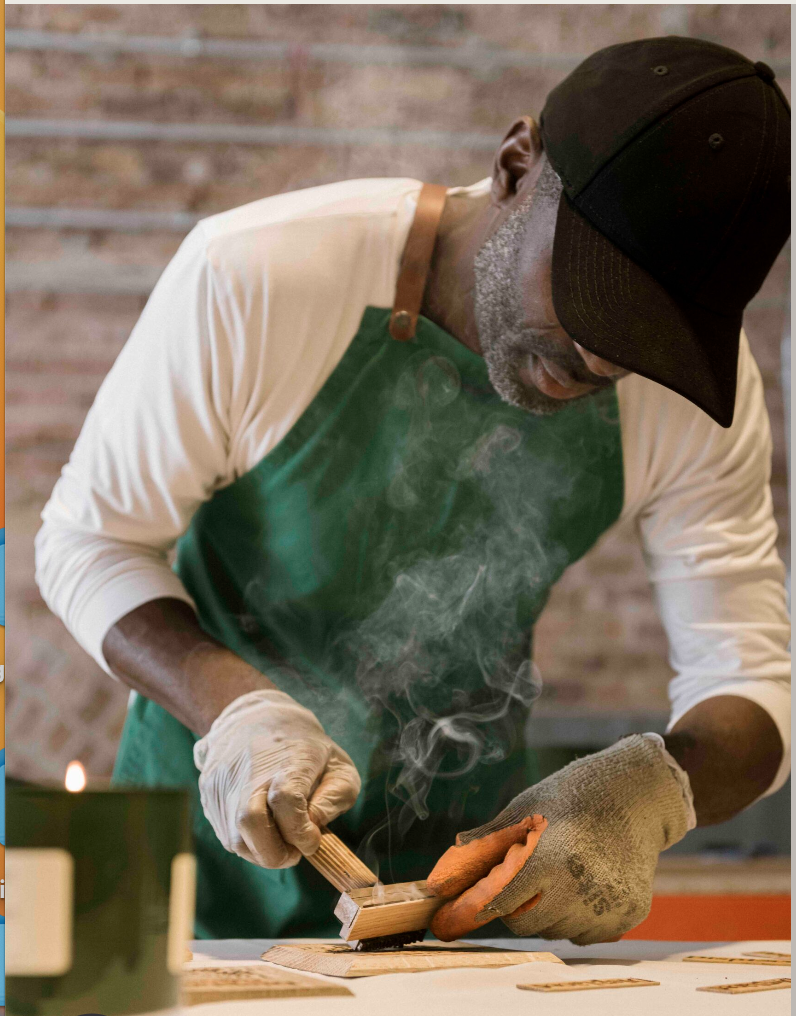
In 2010, a man in North London started making candles on his kitchen table. He had no investors. No business plan worth framing. No connections in the fragrance industry. What he had was twenty years of experience as a sound engineer, an ear trained to detect the smallest imperfection in a recording, and the somewhat irrational belief that the same obsessive attention could be applied to candle wax and fragrance oil.
Fifteen years later, his company produces twenty five thousand units a month for over twenty five luxury brands. It has never had a single product recall. By any reasonable measure, this is an extraordinary business. But here is the interesting thing: by the measure that dominates how we talk about business today, it barely registers.
This is a story about why that logic is broken, and who it was really built for.
• • •
We talk about Jeff Bezos, Bill Gates, and Mark Zuckerberg as though they emerged from nowhere. Garage founders. Dorm room visionaries. Self-made men who pulled success from thin air through sheer brilliance and force of will.
The mythology is seductive. It is also a lie.
Bezos started Amazon after leaving a senior vice presidency at a Wall Street hedge fund. When he needed startup capital, his parents wrote a cheque for $245,573. Not a loan from a bank that took three months and a personal guarantee. A quarter of a million dollars from family, over breakfast.
Bill Gates attended Lakeside, one of Seattle’s most exclusive private schools, where the Mothers’ Club purchased a computer terminal in the late 1960s, at a time when most universities did not have one. His father was a prominent lawyer. His mother sat on the board of First Interstate Banc System alongside the chairman of IBM, a relationship that directly led to Microsoft’s first major contract.
Mark Zuckerberg’s parents, a dentist and a psychiatrist, hired him a private software tutor as a child and sent him to Phillips Exeter Academy, one of the most prestigious prep schools in America, before he went on to Harvard.
Richard Branson, the great British maverick, attended Stowe School, one of the country’s most exclusive boarding schools. His father was a barrister. His aunt loaned him money to grow Virgin Records. And when the young Branson landed in serious legal trouble over a tax dispute in Virgin’s early days, his parents remortgaged the family home to cover a fine of roughly £90,000. Without that bailout, Virgin might have ended before it began. Branson has done extraordinary things and given much back to the world. But the safety net was always there.
These are not stories of people who started with nothing. These are stories of people who started with everything and then built more. That is not a criticism of their talent or their work ethic. It is a correction of the narrative. Because when we hold up these men as the template for what a successful business looks like, we are not just celebrating scale. We are celebrating a starting line that most people, especially those from marginalised communities, will never get to stand on.
• • •
And that is the part nobody talks about.
When you come from a community where there is no family capital to draw from, no generational wealth, no network of contacts who can open doors with a phone call, the economics of starting a business are fundamentally different. You are not choosing between venture capital offers. You are choosing between the electricity bill and a batch of raw materials. You are not iterating on a minimum viable product in a co-working space. You are making the product in your kitchen and delivering it yourself. Trust me, I know.
The system was not designed for you. Supply chains are built around volume that makes it nearly impossible for a small producer to compete on price, even when the product is demonstrably superior. And the funding landscape—the grants, the angel investors, the accelerator programmes—they flow overwhelmingly towards people who already look and sound like the people writing the cheques.
And nowhere is this more visible than the British high street. Walk down any town centre today and you will see the same street repeated in every postcode. Another Greggs. Another Gail’s. Another Holland & Barrett. Another Pret, another Costa, another identical shopfront with identical branding selling identical products at identical prices. The high street has not evolved. It has been photocopied. And every new chain outlet that opens is another nail in the coffin of the independent business that used to give that street its character, its identity, its reason to exist.
We do not need another Greggs. We need the baker who has been supplying the neighbourhood for twenty years and knows every customer by name. We do not need another Holland & Barrett. We need the independent wellness shop run by someone who actually understands the products they sell because they formulated them, not because head office sent a planogram.
But the system does not see it that way. Local authorities, the very bodies that should be championing independent businesses, have largely abandoned them. Business rates are punishing. Planning decisions favour chains who can guarantee long leases and corporate covenants. Regeneration schemes are designed around anchor tenants, not local makers. The language is always about “footfall” and “viability,” never about community or craft.
• • •
And then there are the landlords.
Not anymore.
In 2019, Network Rail sold over 5,200 railway arches on a 150-year lease to a joint venture between Blackstone, the American private equity giant, and Telereal Trillium. They called it The Arch Company. It made Blackstone the UK’s largest small business landlord overnight. The deal was worth £1.46 billion. In 2021–22, The Arch Company reported a profit of £45 million.
The tenants paid for that profit.
And when they cannot pay, the arches do not fill with new independent businesses. They sit empty. A quarter of The Arch Company’s portfolio across the country is vacant. In parts of East London, the number of empty arches rose from 900 to 1,300 in a single year. Corporate landlords would rather leave a unit empty for five years than negotiate a rent a small business can actually afford.
The human cost is not abstract.
Richard Enver ran Dunstan Garage with his brother Hasan. When they were told to pay market rent or move to a smaller arch, the reduction in space made their business unviable. Under immense stress, Richard took his own life the day after he received the notice to vacate. The arch has been empty for five years.
Len Maloney ran JC Motors on Stean Street in Hackney for over forty years. He trained young people through links with twelve local schools and colleges. He was known across the community for going above and beyond. In 2018, Places for London—TfL’s property arm—tripled his rent from £22,000 to £72,000. By November 2024, despite a campaign backed by thousands of local residents, he was evicted. His arch will likely sit empty while the landlord waits for a tenant who can pay more.
I am a member of the East End Trades Guild, an alliance of over 400 independent businesses in East London. We have watched this happen to our members. We have fought for social value leases, for community land trusts, for any recognition that these businesses are worth more than the rent they can pay. And we have been told, repeatedly, that market rate is market rate.

But who created that market value in the first place? Not Blackstone. Not Telereal Trillium. Not the property managers in glass offices. It was the mechanics and the brewers and the bakers and the makers who showed up every day for decades and made those arches worth something. And now they are being priced out of the very value they created.
• • •
This is not a natural evolution. It is extraction. It is a system designed to favour those who already have the most. The big get bigger. The small get priced out. And we lose something we cannot get back.
And yet.
The man in North London is still there. And so are thousands like him, across every industry where making something well still matters. They have survived not because the system supports them, but despite the fact that it does not.
Small and medium businesses account for over 99% of all UK businesses and employ around sixteen million people. They are not the margins of the economy. They are the economy. But you would not know it from the way policy is written, the way funding is allocated, or the way success is defined.
So here is what needs to be said plainly: your business does not have to be Amazon. It does not have to be Facebook. It does not have to scale to a billion-pound valuation to matter.
But we do need to work together to change the rules.
A business that employs five people in your local area matters. A business that makes something with care and integrity matters. A business that keeps a craft alive, that trains apprentices, that gives someone their first job—that matters. A manufacturer producing thousands of units with zero recalls over fifteen years matters more than any growth hack or Series A funding round.
Not every business needs to disrupt an industry. Some of us are here to sustain one. Not every founder needs to be on the cover of Forbes. Some of us would rather be in the workshop at six in the morning, making sure the product is right.
The high street does not need another Greggs. The arches do not need another dark kitchen for Deliveroo. The world does not need another unicorn.
It needs more of us. Stubborn, skilled, small, and still standing. Not every business has to be Amazon. Some of us just have to be good.