Introducing Ceramasistas!
Photographs by Sarah Ainslie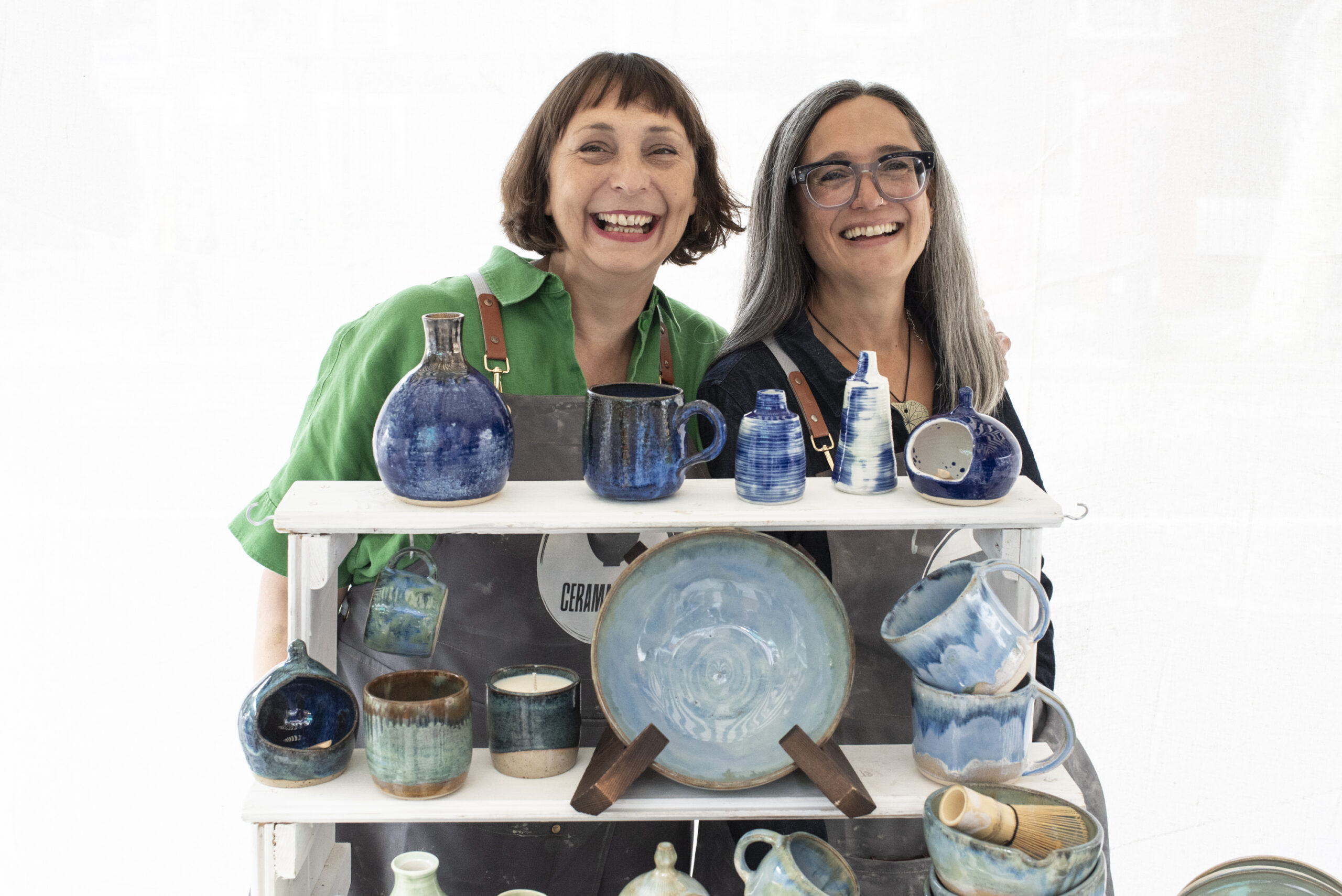
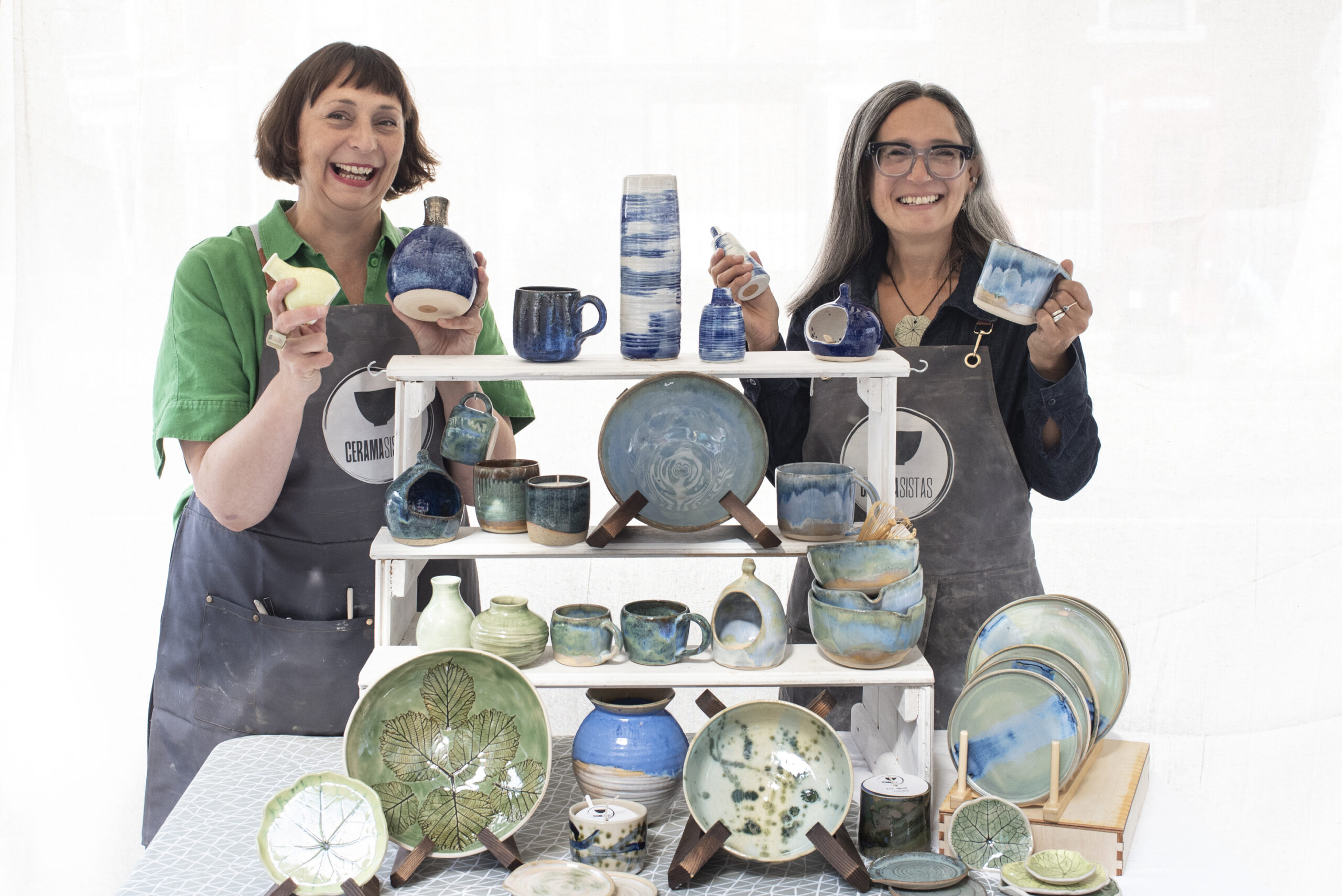
Friends Karen and Gill are the makers behind Ceramasistas. This thoughtful small-batch ceramics studio began with a birthday pottery class and grew into a practice rooted in friendship and craft. From a garden shed studio to the shared tables of East London markets, their journey speaks of the calm joy that creativity brings, the beauty of the slow art, and the empowerment and personal agency that working with clay has given them. Ahead of our Bethnal Green Market on 1st November, they share their story.
Gill: So, yeah, we’ve been friends a long time. For Karen’s birthday a few years ago, I said, “What would you like to do or have for your birthday?” and she said, “I think I’d like to do a pottery class.”
So we just went on some random website, found a local pottery class, taster session, booked it — and we both utterly fell in love with clay at that point.
We did a beginners course, then an intermediate one, and we were lucky enough to be offered membership of the studio. It’s just grown from there, really.
Karen: That very first taster class — I looked across at Gill, who’d been having a really tough time post-COVID, struggling with work, and I looked over and it was the first time in quite a while that I’d seen her face full of life. She just mouthed to me, “I love this!”
It was that thing where, for that moment in time when you’re throwing on the wheel, you can only focus on the clay that’s in front of you. And it’s a bit of a cliché that it’s a mindful activity, but both of us have quite full-on jobs, and actually being able to switch off — not be a mum, not be providing for the family — but just focus for two or three hours on what’s in front of you, which is a piece of clay, mud and water, and make something beautiful or functional, gives you such a tremendous sense of well-being.
Gill: We started our journey with a member studio in Stoke Newington called Cernamic, which is an amazing collective — really inclusive. The members range from about 10 to 100, from all walks of life, all sharing a love of pottery.
Then my lovely dad came down to visit me last summer and saw that we had a shed at the end of the garden that was falling down. He said, “That needs to come down.” And I said, “Yes, I know it does, Dad, but, you know, money and all of that.”
And he said, “And you need somewhere to make your pots.” Then he very kindly gave me a bit of money to build a studio at the end of the garden, which is what we did.
We managed to get the equipment we needed through doing little markets here and there. Pottery’s not exactly what one would say is a cheap hobby!
Karen: We worked really hard. We make what we love to make, and everything starts with probably an immediate need that we’ve had.
We got involved with a couple of markets through a collective called GoEast, who do flea markets, and they were so encouraging.
We’d never really done markets before, and we were just blown away by the locals in Walthamstow — they were so supportive and helpful. People in East London are just generally really tuned into handmade things that have a real story to them.
Both of us have experience in retail, so when people engage with us at our stall, we love telling our story. That connection really helps us sell, but it also makes it meaningful.
We’d both say that we are not incredibly accomplished makers. We don’t make lots of things that are exactly the same — and we take pride in that.
We’re not a studio pottery where we manufacture the same things. We’re much more about making things in small batches that are a little bit quirky.
We focus on the glaze combinations and want people to really enjoy what we’ve made.
Gill: Yeah, and at the ripe old age of nearly 53, I don’t think I’m ever going to learn to make things identical — and at this stage of our lives, quite frankly, that would be boring. We do it because we love it, and it’s a release.
Gill: Nature is a huge inspiration for us. The leaf plates started early on in our pottery journey. I had a jungle of nasturtiums in my garden, and I really liked their aesthetic, so I started pressing them into clay.
They’ve evolved into something that people really like. And Karen’s also really inspired by natural forms — lichens, corals, shapes, textures.
Karen: Gill has a real meditative process when she’s making her leaf plates. She goes out into the garden, hand-selects a leaf, presses it into clay, forms it, and then does the same thing constantly for hours.
Every surface ends up covered in leaves in various shapes and sizes. You can’t do it fast — you have to do it slow. The joy is in taking time to make something, spending that time crafting it, and allowing yourself to get lost in it.
You can’t hurry clay. If you hurry it, it doesn’t work — it fights back, it breaks.
Gill: It’s honestly so true — the slower you go, the better it turns out. Karen has an art background, whereas I don’t, and I can always see the real difference between our work. She’s the artist; I’m much more utilitarian. That mix works really well for us.
Karen: I started my London life in Bethnal Green. I lived there for about five years — near Columbia Road.
I remember bleary breakfasts at Pellicci’s on a Saturday morning, 5 a.m. bagels after late nights, and a shared studio under the Truman’s Brewery chimney — with dead pigeons above and bubble wrap below! It was such a fabulous and eclectic time.
We couldn’t afford to buy a house there, so we moved to E17, and now we’re in E7. My husband’s from Forest Gate, his parents from Maryland, and his grandparents from East London. They love pie and mash and have passed that down — my daughter’s a true Londoner through and through.
I studied art in Nottingham but grew up in Suffolk, between Bury St Edmunds and Diss. My partner’s a proper East London boy, so I was always destined to end up here.
I used to be a painter, working with paper and mark-making, and I use similar ideas now — only with clay and glaze instead of ink and paint.
We take pride in keeping prices accessible.
Gill: We want people to actually buy and use what we make. People often tell us we should charge more, but we like the fact that our work is affordable.
We sell a lot of small things to people in their late 20s or 30s, probably just setting up home, who want something unique that you can’t buy in IKEA. Maybe one day we’ll make big statement pieces, but most of us don’t live in houses with space for those anyway!
We’ve got cups and mugs of all sizes — from espresso to big mugs — plus bowls, lemon squeezers, and salt pigs.
Karen: And then there are the bud vases. Most potters have a “happy throw” — a form they always return to. Mine is little vases.
I made 30 of them for my Hungarian friend Bogi’s wedding in London — one for each table setting. We gifted them to her as her wedding present.
None of them match — they’re all slightly different, sometimes glazed in new combinations depending on how I feel with the brush in my hand.
Having five or six or seven little vases on a table or mantelpiece, each with a single flower or leaf, is such a lovely way to brighten up a space.
Gill: What excites us the most is being part of this lovely collective. It’s such an eclectic group of makers in a vibrant part of London.
We’re really looking forward to meeting other women makers, sharing skills, learning from each other, and supporting one another.
We’ve got Christmas nailed, quite frankly! But it’s that sense of camaraderie and encouragement that makes this special.